Amazon's Letter to shareholders signals Amazon becoming a system, not a company
AI, Robots, Groceries, and Satellites — Amazon Is Betting $200 Billion That Everything Will Change
Andy Jassy opens his 2026 shareholder letter not with a sales pitch but with a philosophy: progress is rarely linear, and the companies that win are those willing to go back to the starting line, even when things are working . With total revenue growing 12% to $717 billion and operating income up 17% to $80 billion, Amazon is clearly working — but Jassy's letter is a signal that the company considers its current success a launchpad, not a destination.
Replacing Friction with Speed
The transformation of Amazon's fulfilment network is the clearest example of how the company turns scale into a structural advantage. Over one million robots now operate across its centres, not simply as cost-cutting tools but to eliminate the physical strain on workers while simultaneously enabling faster, cheaper delivery of a wider selection . Rather than betting on a single solution, Amazon is running three delivery speed experiments in parallel — 85-plus Same-Day Fulfilment Centres that have already handled 500 million same-day units in 2026, Prime Air drone delivery now designed to reach 30 million customers by year-end, and Amazon Now's 20-minute ultra-fast service, which is growing 25% month-on-month in India alone . Jassy is explicit that these are complementary, not competing — drones will launch from the same SSDs used for same-day delivery, while Amazon Now serves a different, more immediate need. At the same time, Amazon is committing $4 billion to extend this speed to rural America — 13,000 zip codes and 1.2 million square miles that most logistics providers have retreated from.
Grocery: Two Decades of Experiments, One Breakthrough
Amazon has been chasing the grocery opportunity for 20 years, and Jassy's letter frames the current moment as the point where experimentation has finally given way to clarity . The decisive breakthrough was integrating perishables — fresh produce, dairy, meat — into its Same-Day Delivery network in early 2025. The response was immediate: perishables sales grew 40-fold and now account for nine of the ten most-ordered same-day items wherever available . Whole Foods is expanding beyond 550 stores with 100 more planned, and a new smaller format, Daily Shop, is being rolled out in urban neighbourhoods for frequent, quick grocery runs . Taken together, Amazon's grocery operation has grown to over $150 billion in gross sales, making it the second-largest grocer in the United States.
Alexa: A Complete Rebuild, Not a Refresh
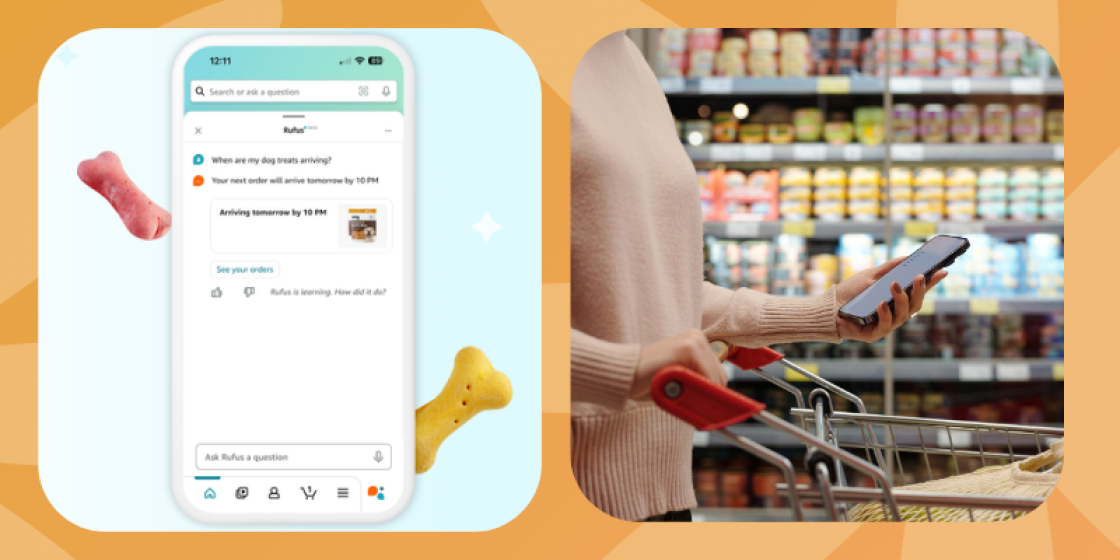
Alexa+ represents one of the most candid admissions in the letter — that Amazon had to tear down and rebuild its most well-known consumer product entirely . With 600 million active endpoints across devices, cars, Fire TV, and Prime Video, Alexa had scale but lacked the intelligence that generative AI now makes possible. Rather than layering AI on top of the existing architecture, Amazon rewired Alexa's entire brain — its reasoning, its routing, the range of services and APIs it can access, and the tasks it can complete autonomously . The results validate the disruption: customers are talking to Alexa twice as much, completing purchases three times more often on devices, streaming music 25% more, and using smart home features 50% more . Jassy is clear this is still early — but the direction is towards a personal assistant capable of genuinely agentic commerce, acting on a customer's behalf rather than simply responding to commands.
Advertising: Growing Deeper, Not Just Wider
Amazon's advertising business is evolving beyond the sponsored listings that originally defined it. Jassy highlights Prime Video, Pharmacy, and Grocery as newer advertising surfaces that are growing robustly and improving their own economics in the process . The opportunity here is structural — as Amazon embeds itself more deeply into where customers shop, eat, watch, and order prescriptions, it creates advertising inventory that reaches consumers at uniquely high-intent moments that no other platform can replicate.
AWS: The Infrastructure of the AI Era
Much was said in the letter about AWS being the engine room of the business. Jassy claims that Amazon is not simply benefiting from the AI boom, but reshaping it. AI has fundamentally changed who AWS's customers are and what they need. Enterprises are no longer just renting storage and compute — they're running large AI models, training custom agents, and deploying autonomous workflows at scale. That shift has driven AWS's AI revenue to a $15 billion quarterly run rate, with Amazon's own Trainium chips giving it a cost and margin edge over competitors
The Future of Amazon: A System, Not a Company
What Jassy's 2026 letter ultimately reveals is not a collection of business units — it is a converging system. Drones launch from SSDs. Alexa+ drives agentic commerce. Amazon Leo feeds data into AWS. Trainium chips lower the cost of running all of it. This full-stack integration — from chips to satellites to smart speakers to grocery shelves. It gives Amazon structural advantages that are extraordinarily difficult to replicate. As physical retail migrates online and AI reshapes every consumer interaction, Amazon is uniquely positioned to own the infrastructure, the interface, and the intelligence layer simultaneously. The free cash flow dip is a deliberate trade: short-term constraint for long-term dominance. If Jassy's bets land — and the letter's data suggests most already are — Amazon in 2030 could look less like a retailer and more like the operating system of global commerce itself.