Amazon's Latest Advertising Evolution is Easy to Miss
Amazon’s latest advertising evolution is easy to miss. With the rollout of Sponsored Products and Sponsored Brands prompts, the company is quietly redefining how ads show up in a generative AI shopping experience.
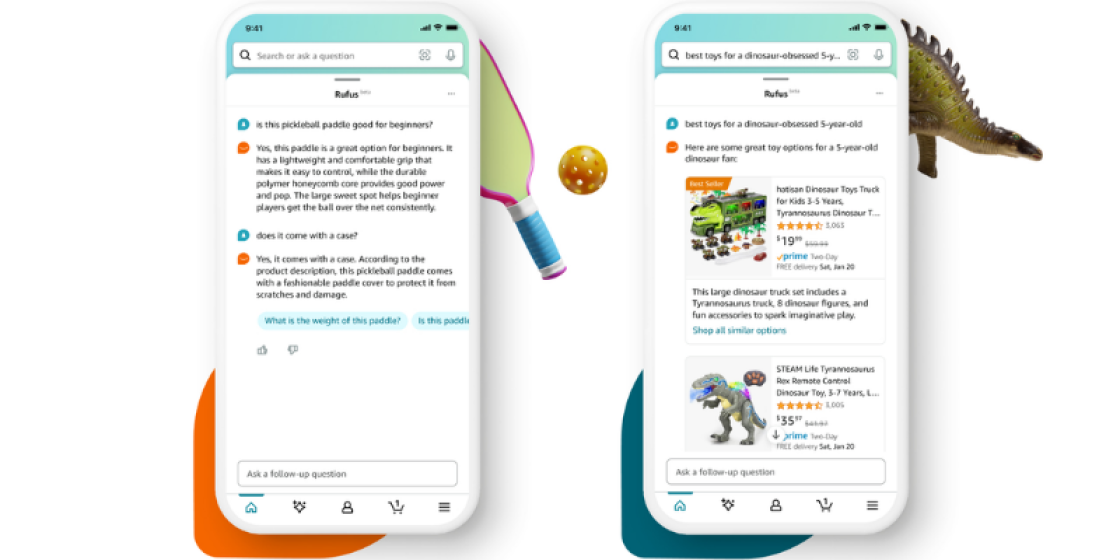
At the centre of this shift is Rufus, Amazon’s AI-powered shopping assistant. Rather than relying on keyword searches alone, Rufus allows shoppers to ask natural-language questions, compare products, and explore use cases conversationally. This fundamentally changes how intent is expressed, and therefore how it must be captured by advertisers.
Sponsored Products prompts sit directly inside this experience. Instead of appearing as traditional placements in search results, products are surfaced within AI-generated responses to shopper queries. In practice, that means your product is now recommended as part of an answer.
This is a structural shift. Historically, Amazon Ads has been built on keyword targeting and auction dynamics. Prompts move beyond that model. They are generated automatically using Amazon’s first-party data (product detail pages, reviews, campaign signals) and inserted at moments of high intent in the shopping journey. The result is something closer to a “virtual product expert” than an ad unit.
For advertisers, the implications are significant.
Control is changing. You are not writing these prompts; Amazon’s AI is. The inputs that matter are your listing quality, structured data, and how clearly your product answers real customer questions. This elevates the importance of content strategy - copy, imagery, and reviews - far beyond conversion rate optimisation.
Competition is also being reshaped. Early beta results suggest meaningful incremental sales, often at little to no cost during testing phases. But as with previous Amazon ad innovations, this will likely transition into a paid, auction-based environment. Brands building data and learning now will be better positioned when scale and pricing mature.
Most importantly, this signals where retail media is heading. Amazon is not just adding another format, it is embedding monetisation directly into AI-driven discovery. The distinction between “organic” and “paid” becomes increasingly blurred when recommendations are generated conversationally.
For senior ecommerce and advertising leaders, the takeaway is clear: optimisation for AI-mediated shopping is no longer optional. Success in this environment will depend less on keyword coverage and more on how well your product can be understood, interpreted, and recommended by machines.